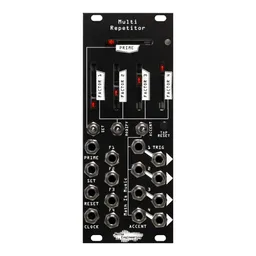
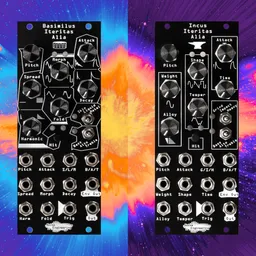
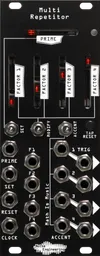
Last month, we introduced Multi Repetitor, our next-generation rhythm generator and sequel to the Numeric and Zularic Repetitor. We’ve talked about how it works and some fun ways to patch it, but today, we’re pulling back the curtain and sharing a bit about its (surprisingly long) backstory and what went into developing this deceptively simple module.
How it started
Way back in 2014, Numeric Repetitor and Zularic Repetitor were born. They filled a fun niche in the (then much smaller) Eurorack market: generate rhythms with an absurdly simple interface in a way that was fun to jam on the fly. Even ten years after their original release, they were still quite popular and had a bit of a cult following of dedicated fans.
While they shared the same design concepts, worked slightly differently.
Zularic Repetitor derived its based rhythms from theory books and a fun drum machine that Stephen borrowed from a friend. The base rhythm for the four outputs could be selected with the top parameter (or CV), and the bottom three outputs could have their rhythms offset in time with their respective parameters (or CV inputs) to create variations.
Numeric Repetitor’s base rhythms were derived from a simple mathematical algorithm, and used the same method of selecting a base rhythm for the outputs. But instead of offsetting the rhythmic timing like Zularic, Numeric’s output parameters instead added a multiplier to the algorithm, creating a variation of the output’s pattern.
These ultra-simple designs lent themselves perfectly to live performance: as soon as you patched a clock in, you had a sequence, and you could easily create variations on the fly with the adjustment of a single parameter.
Numeric and Zularic Repetitors shared a hardware, but were built on an old and less-than-flexible chip so users couldn’t swap between the two. Once we saw how popular they were, we knew we’d want to revisit the concept of rhythmic generators at some point, and in the early 2020s we started seriously discussing design concepts.
Prototyping
As always, we started by throwing a huge number of concepts together and seeing what stuck. Did we want MIDI? USB? Editable patterns? A screen?
When designing a module, especially a sequel, it’s easy for things to snowball into a more-is-more smorgasbord of features.What we eventually realized, though, was that the entire reason the original Repetitors were so darn fun was because they were so darn simple.

The first prototype we built (pictured above, on the left) was simpler than some of the ideas we’d come up with on paper, but was still quite extensive. It was 20 HP (more than twice the size of the original modules) and had a huge selection of inputs, outputs, and parameters. We set up a simple firmware that used Euclidean algorithms to generate patterns. It was kind of fun, but left us feeling unsatisfied: you could create a cool pattern pretty easily, but it was hard to smoothly change into a different pattern without some fiddling.
That prototype did teach us that we wanted to use faders, though. We’d started using faders more when we introduced Lapsus Os, and all really enjoyed how they felt as performance tools. This was no exception – they were great to use in a jam.
In the time between the original prototype and the next round of development, Stephen did a bunch of performances using a gigantic sequencer prototype that had yet to see the light of day. This was an even more complex prototype that was conceptualized to be an end-all be-all sequencer. Stephen started out with a comprehensive firmware, but kept refining things for his performance case until he, hilariously, ended up with something that was effectively a beefed-up Numeric Repetitor. This informed the next design quite a bit, as we had a much better idea of what interface elements really mattered, and what didn’t.
When revising for the next prototype, we decided to aim for something really compact. We also decided to introduce accent outputs, something we’d first contemplated with Confundo Funkidos. More rhythm-related outputs meant more fun ways to bring a patch to life without increasing cognitive load during a performance.
The second-to-last prototype (pictured above, in the middle) was close to what we ended up releasing, but featured a similar display to the original Repetitors. While it was nice being able to reference a rhythm in a document, we never really wanted to bring a chart of rhythms in our live systems, and always ended up selecting rhythms by ear anyway. We decided that the less-is-more approach was really what we should have been doing all along, and removed all but one LED to display rhythm progression (and a few other key features). The faders had LEDs we could use to display outputs, which was the important feedback anyway.
This also let us add in a third switch, which was important for adding some flexibility in how the module generated patterns.
The final versions
Once we had a final hardware, the only thing left to do was verify that it worked (a refreshingly simple task on a trigger-based module) and then develop some firmware. We wanted to include rhythm banks from the original Zularic and Numeric, as well as some new Euclidean-derived patterns we’d found to be really interesting.

Since we had four faders, we could apply modifiers to all four outputs, a welcome upgrade compared to the originals, and could also change how the modifiers affected the resulting rhythm. We’d always wanted to play with Zularic’s timing modification on Numeric, for example, and now we could do that! We also added a new algorithm that allowed each output to have its base rhythm adjusted, a fun option that wasn’t possible with the original modules.
Another feature that we’d learned from developing Mimetic Digitwolis was that making sequencers work independently or with other clocks greatly increased their flexibility. A simple tap-tempo was more than enough for what Multi Repetitor needed to do, so after some panel edits it was multiplexed to be either a manual reset or a clock selector.
Generating accent patterns that were interesting was the part that took the longest. We tried a few different options but found that we kept creating patterns that were either fatiguingly repetitive or just uninteresting. After extensive experimentation we came up with the idea for the mute position, and the complex yet effective algorithm that you can find in the released module.
Get yours
Whether you’re a longtime fan of the original Repetitors or just need a rhythm generator for your skiff, Multi Repetitor is available now from your favorite retailers or the Noise Engineering webshop. We’re really proud of what this compact and effective sequencer can do, and we can’t wait to see the patches and jams you create with it.