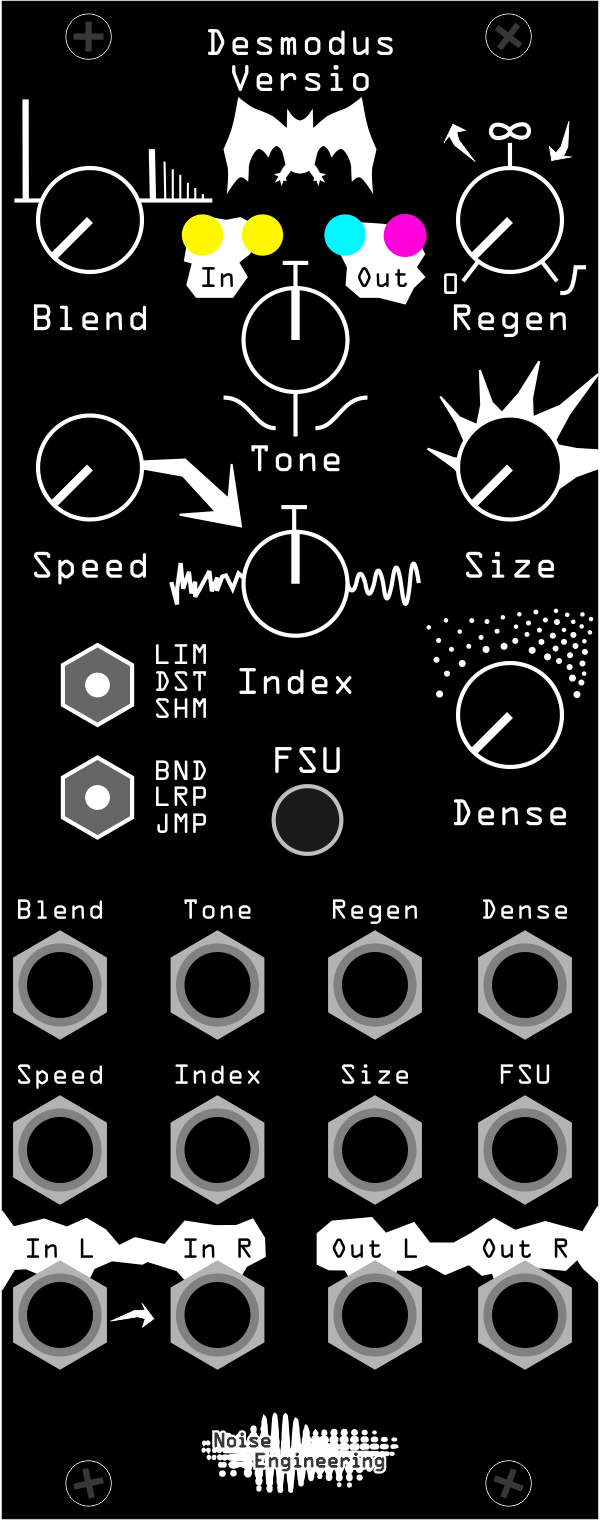
Guest post: DUB-Russell on creating WTF Versio
Today, we’re chatting with DUB-Russell, creator of the intriguing WTF Versio firmware, about his development processes, inspirations, musical background, and more.
What inspired you to create this firmware?
I originally developed an INSANE beat machine app called 2020 THE SEMI MODULAR BEAT-MACHINE. It already had a real-time granular engine inside it.
While experimenting with live setups that combined 2020 and modular, got curious about what would happen if I brought that granular engine over to Versio.
That curiosity became the starting point for WTF!
I also personally love those moments where you accidentally discover sounds during a performance — the kind of sounds you could never intentionally design beforehand.
WTF! was built as a tool for creating those unpredictable but musical moments.
Did the firmware end up evolving beyond your original idea?
A lot more than I expected.
At first, it was just a simple experiment to see if 2020's granular effect engine could run on Versio. But once I started adding random systems like Probability and Variation, it slowly became something closer to a semi-autonomous instrument that behaves slightly differently every time you play it.
What became really interesting was that it stopped being just a modular version of part of 2020.
The freedom of CV and patching pushed it into much stranger territory, and it started naturally merging with the philosophy of modular itself.
What's your musical background?
I'm based in Tokyo and come from the audiovisual scene.
I've always been obsessed with beats, and I perform improvised live sets using software I built myself — software designed to discover chaotic and accidental sound transformations in real time.
Honestly, I'm not the kind of musician who can carefully place notes onto a timeline and perfectly recreate the music inside my head.
So instead, I started building systems that could generate beats with me using mathematics, probability, and controlled randomness. I began prototyping in Cycling'74 Max, eventually learned C++ and JUCE, and that process ultimately became 2020.
How did you get into modular?
After years of making beats only with software I built myself, I started craving a completely different kind of stimulation.
But I wasn't very interested in expanding my sound through DAWs or plugins, so I began building a hybrid live beat-making system that combined 2020 with DJ gear and modular.
The first modules I bought were Mimetic Digitalis, Electus Versio, and BIA — haha.
Discovering the philosophies and beautiful obsessions behind modular manufacturers like Noise Engineering was a huge inspiration for me.
Now, modular-inspired ideas have also found their way back into 2020 itself.
Discovering the philosophies and beautiful obsessions behind modular manufacturers like Noise Engineering was a huge inspiration for me.
I added Turing Machine-like systems to its nearly 700 parameter randomizers, and even built clock and trigger outputs designed to directly drive modular gear.
Going forward, I want to keep exploring more hybrid systems that blur the line between software and modular.
How did you start developing for the Versio platform?
I was already using Ruina Versio, Electus Versio, and Alia modules, so I never really worried about whether the DSP power would be enough.
Versio also has stereo I/O, enough knobs and CV inputs, and accessible example projects, so it felt like the perfect playground for my experiments.
What part of the firmware are you personally most proud of?
Probably the fact that a single gate input can handle both BPM synchronization and timing-based sound variation.
Of course, perfectly estimating the BPM of every rhythm pattern is impossible, but I'm honestly surprised by how many patterns it can analyze musically in practice.
I'm a "bit" maximalist, so I'm pretty satisfied with the result.
What tools, languages, or workflows did you use during development?
The firmware was developed in C++ and CMake using the Versio example project from the libDaisy repository as a starting point.
A lot of the process involved rebuilding, flashing, listening, tweaking, and repeating that cycle endlessly on the actual hardware.
The trigger-to-BPM estimation system was especially difficult to tune entirely by ear on hardware, so I built a separate command-line testing tool that could evaluate huge numbers of beat patterns and BPM combinations automatically.
That helped me improve the detection accuracy much faster.
Do you have any advice for people interested in creating their own firmware?
Honestly, thanks to the publicly available examples, it's much easier than people probably imagine.
If you have the obsession, you can absolutely do it.
And even if your experiment fails, Versio already has tons of amazing official firmware anyway, so there's basically no downside.
I'm excited to see more firmware out there that makes people say "WTF!"
Where can people learn more about you and the firmware?
You can find everything here: